This article is being expanded for more depth. Check back soon!

Larynx Anatomy Functions Nerve Supply Muscles Cartilages Clinical Importance
Author: Medical Editorial Team – Board-certified physicians with 10+ years in emergency medicine. Learn more.

Illustration of Larynx Anatomy Functions Nerve Supply Muscles Cartilages Clinical Importance symptoms

Medical Disclaimer: This is educational content only, not medical advice. Consult a licensed healthcare provider for diagnosis/treatment. Information based on sources like WHO/CDC guidelines (last reviewed: 2026-02-13).

About the Author: Dr. Dinesh, MBBS, is a qualified medical doctor with over [2 years – add your experience] of experience in general medicine As the owner and lead content creator of LearnWithTest.pro, Dr. Dinesh ensures all articles are based on evidence-based guidelines from sources like WHO, CDC, and peer-reviewed journals. This content is for educational purposes only and not a substitute for professional medical advice.

Contact Details: For inquiries or collaborations, reach out at:

All content is reviewed for accuracy and updated regularly (last review: January 10, 2026). We prioritize trustworthiness by citing reliable sources and adhering to medical ethics.

Frequently Asked Questions

What is the larynx?

The larynx is a hollow fibrocartilaginous organ of the upper respiratory tract located between the pharynx and trachea. It plays a key role in phonation, respiration, and protection of the lower airway.

At which vertebral levels is the larynx located?

The larynx extends from the level of the C3 to C6 vertebrae in adults.

What are the main functions of the larynx?

The main functions of the larynx are voice production, maintenance of a patent airway for breathing, prevention of aspiration during swallowing, and initiation of the cough reflex.

How many cartilages form the larynx?

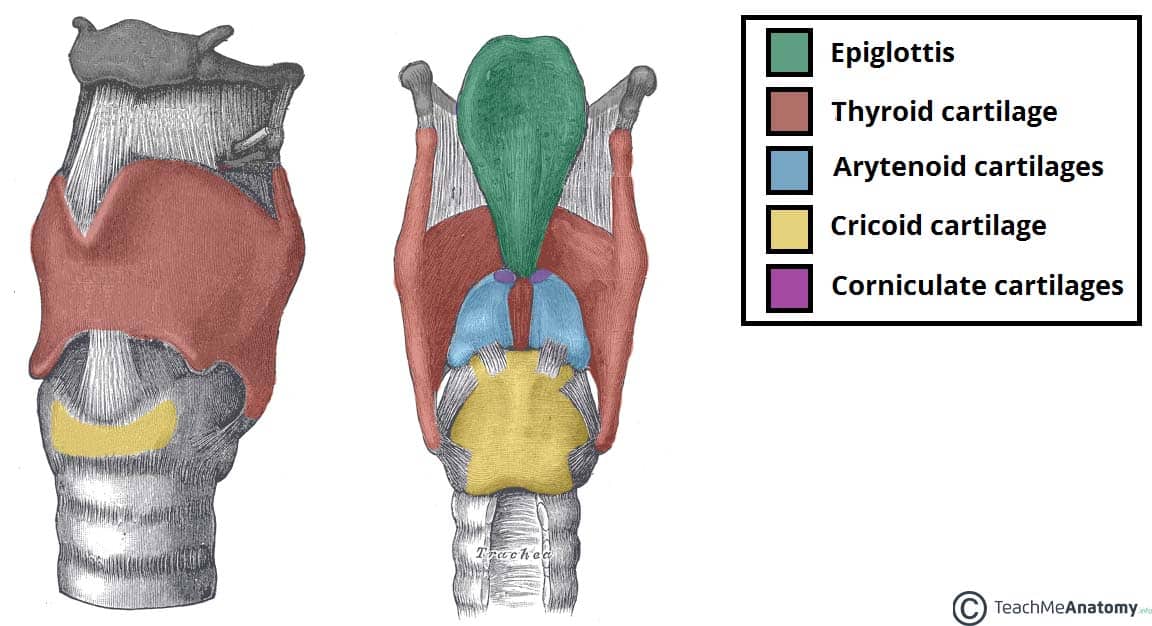
The larynx is formed by nine cartilages: three unpaired (thyroid, cricoid, epiglottis) and three paired (arytenoid, corniculate, and cuneiform).

Which cartilage forms a complete ring in the larynx?

The cricoid cartilage is the only laryngeal cartilage that forms a complete ring around the airway.

What are the main parts of the laryngeal cavity?

The laryngeal cavity is divided into the vestibule, ventricle, and infraglottic cavity.

What is the difference between true and false vocal cords?

True vocal cords are involved in phonation and contain the vocal ligament, while false vocal cords (vestibular folds) are primarily protective and do not produce sound.

Which muscle is the only abductor of the vocal cords?

The posterior cricoarytenoid muscle is the only muscle that abducts the vocal cords.

What is the nerve supply of the larynx?

Motor supply is mainly by the recurrent laryngeal nerve, except the cricothyroid muscle which is supplied by the external laryngeal nerve. Sensory supply above the vocal cords is via the internal laryngeal nerve and below the cords via the recurrent laryngeal nerve.

What is the function of the epiglottis?

The epiglottis prevents food and liquids from entering the larynx during swallowing by directing them toward the esophagus.

Why do vocal cord tumors present early with hoarseness?

Vocal cord tumors affect cord vibration even when small, leading to early hoarseness due to disruption of normal phonation.

What is the clinical importance of the cricothyroid membrane?

The cricothyroid membrane is the preferred site for emergency airway access during cricothyrotomy.

What happens in unilateral recurrent laryngeal nerve injury?

Unilateral recurrent laryngeal nerve injury typically causes hoarseness of voice due to paralysis of one vocal cord.

What happens in bilateral recurrent laryngeal nerve injury?

Bilateral injury causes paralysis of both vocal cords in a near-midline position, leading to severe airway obstruction and stridor.

Why is lymphatic spread limited in glottic cancers?

Glottic cancers spread late because the true vocal cords have very poor lymphatic drainage.

MCQ Test - Larynx Anatomy Functions Nerve Supply Muscles Cartilages Clinical Importance

Progress:
0/20
Time: 00:00

1 A 45-year-old teacher presents with progressive hoarseness and inability to raise pitch. There is no breathing difficulty. Which nerve is most likely injured?

Explanation:

External laryngeal nerve supplies the cricothyroid muscle, which tenses vocal cords and raises pitch.

2 A patient develops stridor following thyroid surgery. Both vocal cords are found near the midline. Which nerve injury explains this?

Explanation:

Bilateral recurrent laryngeal nerve injury fixes cords near midline causing airway obstruction.

3 During an emergency airway procedure, an incision is made through a membrane between thyroid and cricoid cartilages. Which structure is opened?

Explanation:

Emergency cricothyrotomy is performed through the cricothyroid membrane.

4 A singer complains of loss of fine voice control despite normal cord movement. Which intrinsic muscle is most likely affected?

Explanation:

Vocalis muscle fine-tunes vocal cord tension.

5 A carcinoma confined to the true vocal cords shows delayed lymph node metastasis. What anatomical feature explains this?

Explanation:

True vocal cords have very poor lymphatic drainage.

6 After intubation, a patient cannot abduct the vocal cords. Which muscle is paralyzed?

Explanation:

Posterior cricoarytenoid is the only abductor of the vocal cords.

7 Loss of cough reflex above the vocal cords indicates injury to which nerve?

Explanation:

Internal laryngeal nerve provides sensory supply above the vocal cords.

8 A child aspirates a foreign body. Which structure primarily prevents aspiration during swallowing?

Explanation:

Epiglottis closes the laryngeal inlet during swallowing.

9 A fracture affecting the only complete cartilaginous ring of the airway would involve which cartilage?

Explanation:

Cricoid cartilage is the only complete ring of the airway.

10 A patient presents with hoarseness but normal airway patency after neck surgery. Which nerve is most likely injured?

Explanation:

Unilateral recurrent laryngeal nerve injury causes hoarseness only.

11 Damage to which joint would impair both abduction and adduction of vocal cords?

Explanation:

Cricoarytenoid joint allows movement of vocal cords.

12 A lesion affecting the conus elasticus would directly affect which structure?

Explanation:

Conus elasticus forms the vocal ligaments.

13 A patient with superior laryngeal nerve injury is at increased risk of aspiration. Which branch is involved?

Explanation:

Internal laryngeal nerve provides protective sensation.

14 During phonation, which joint primarily adjusts pitch by altering vocal cord tension?

Explanation:

Cricothyroid joint increases vocal cord tension.

15 A newborn has congenital laryngeal stridor due to collapse of supraglottic structures. Which area is primarily involved?

Explanation:

Laryngomalacia affects supraglottic vestibular structures.

16 Which cartilage provides attachment to vocal ligaments anteriorly?

Explanation:

Vocal ligaments attach anteriorly to thyroid cartilage.

17 A lesion below the vocal cords would most likely affect sensation carried by which nerve?

Explanation:

Recurrent laryngeal nerve supplies sensation below vocal cords.

18 A patient loses ability to produce voice but airway remains patent. Which condition best explains this?

Explanation:

Abducted cords allow airflow but prevent phonation.

19 Injury to which muscle would most affect lowering of pitch?

Explanation:

Thyroarytenoid relaxes vocal cords, lowering pitch.

20 A penetrating injury damages the larynx at C6 vertebral level. Which cartilage is most likely involved?

Explanation:

Cricoid cartilage lies opposite the C6 vertebral level.

Test Results

0%
0/20
0
Correct Answers
0
Wrong Answers
00:00
Time Taken
0
Skipped
View Exam Mode MCQs (1766150200-index-2025-12-19T184408.792.html)

Related Articles

Comments