Medical Disclaimer: This is educational content only, not medical advice. Consult a licensed healthcare provider for diagnosis/treatment. Information based on sources like WHO/CDC guidelines (last reviewed: 2026-02-13).
This article is being expanded for more depth. Check back soon!
Basal Ganglia Anatomy Functions Pathways and Clinical Disorders Explained
Frequently Asked Questions
What are the basal ganglia?
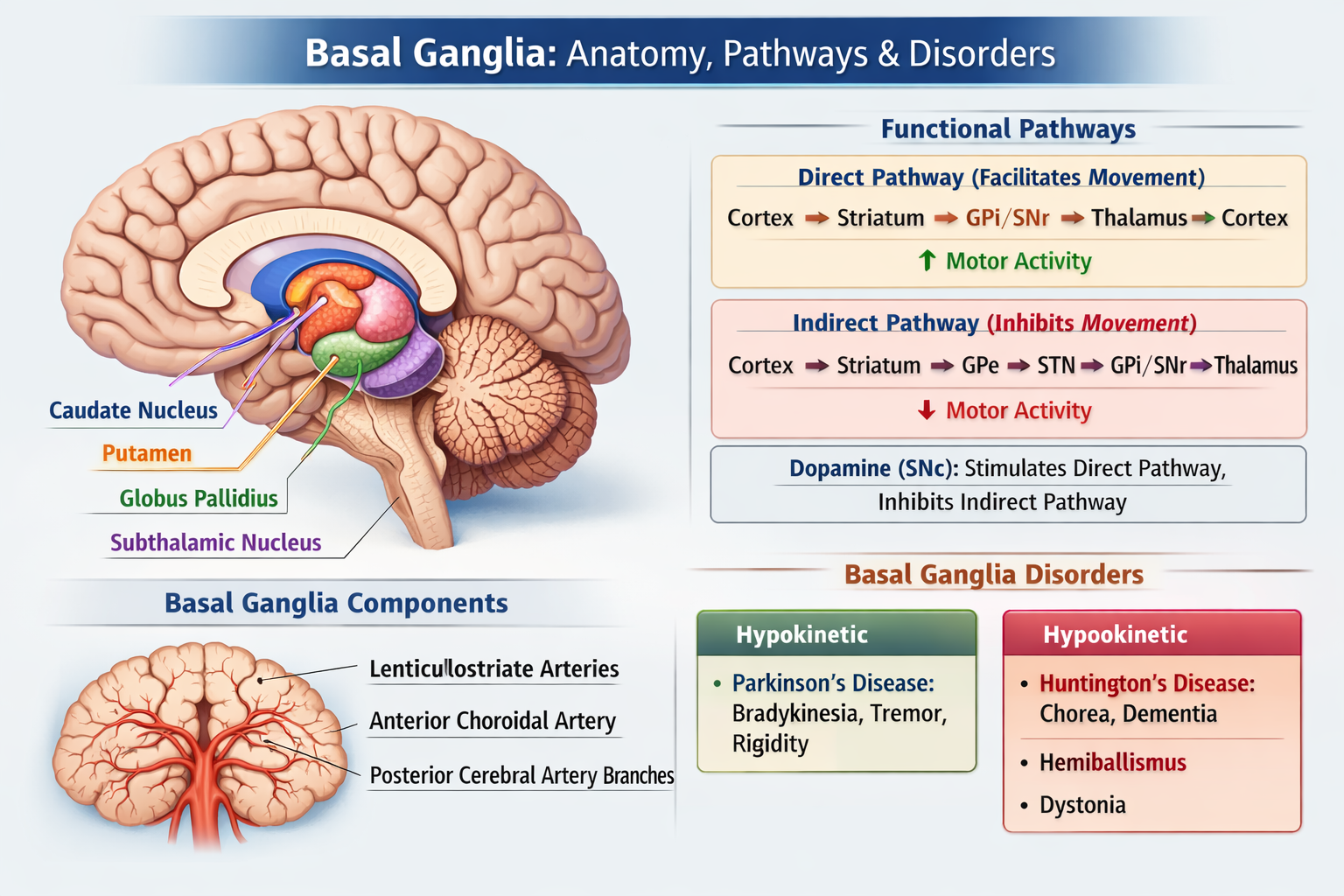
The basal ganglia are a group of deep subcortical nuclei that regulate voluntary movement muscle tone posture procedural learning and certain cognitive and emotional functions.
Which structures are included in the basal ganglia?
The basal ganglia include the caudate nucleus putamen globus pallidus subthalamic nucleus and substantia nigra.
What is the primary function of the basal ganglia?
The primary function of the basal ganglia is to modulate motor activity by facilitating desired movements and inhibiting unwanted movements.
What is the difference between the direct and indirect pathways of the basal ganglia?
The direct pathway facilitates movement by reducing inhibitory output to the thalamus while the indirect pathway inhibits movement by increasing thalamic inhibition.
How does dopamine affect basal ganglia function?
Dopamine from the substantia nigra pars compacta stimulates the direct pathway via D1 receptors and inhibits the indirect pathway via D2 receptors thereby promoting movement.
Which artery supplies the basal ganglia?
The basal ganglia are mainly supplied by the lenticulostriate branches of the middle cerebral artery along with contributions from the anterior choroidal artery.
What happens when the basal ganglia are damaged?
Damage to the basal ganglia results in movement disorders characterized by either reduced movement hypokinetic disorders or excessive involuntary movements hyperkinetic disorders.
Which disease is associated with degeneration of the substantia nigra?
Parkinson disease is associated with degeneration of dopaminergic neurons in the substantia nigra pars compacta.
Which basal ganglia structure is primarily affected in Huntington disease?
Huntington disease primarily affects the caudate nucleus leading to chorea behavioral changes and cognitive decline.
What is hemiballismus and which structure is involved?
Hemiballismus is a hyperkinetic movement disorder characterized by violent flinging movements caused by lesions of the subthalamic nucleus.
MCQ Test - Basal Ganglia Anatomy Functions Pathways and Clinical Disorders Explained
Progress:
0/0
Time: 00:00
No MCQs available for this article.