Medical Disclaimer: This is educational content only, not medical advice. Consult a licensed healthcare provider for diagnosis/treatment. Information based on sources like WHO/CDC guidelines (last reviewed: 2026-02-13).
This article is being expanded for more depth. Check back soon!
Development of Tongue, Pituitary Gland, Face, Palate and Thyroid – Complete Embryology Guide
Frequently Asked Questions
From which pharyngeal arch does the anterior two thirds of the tongue develop?
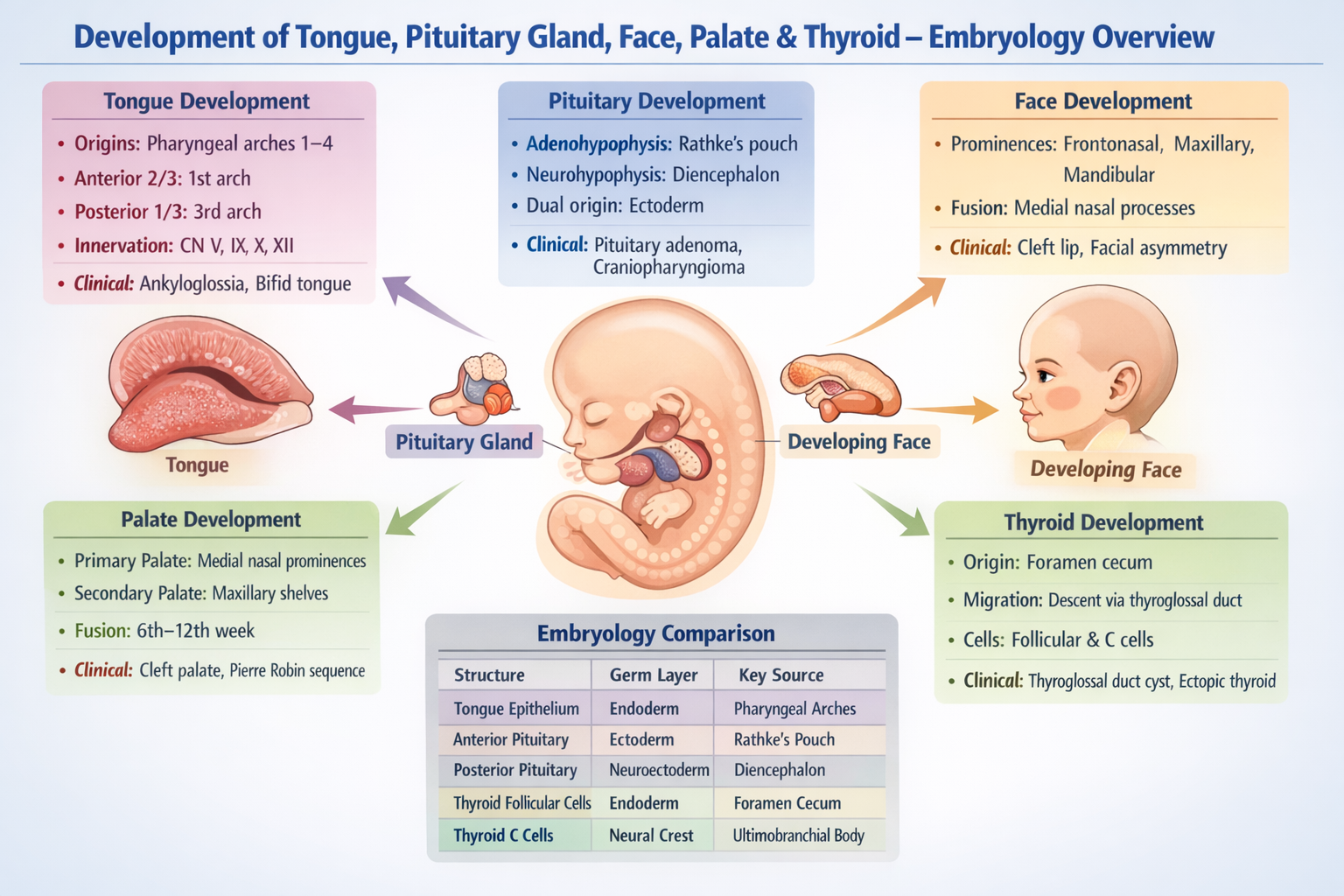
The anterior two thirds of the tongue develop from the first pharyngeal arch through the lateral lingual swellings.
Which pharyngeal arch forms the posterior one third of the tongue?
The posterior one third of the tongue develops from the third pharyngeal arch.
What is the embryological origin of tongue muscles?
Tongue muscles originate from occipital myotomes and are supplied by the hypoglossal nerve.
What are the embryological components of the pituitary gland?
The pituitary gland has a dual origin: the anterior pituitary develops from Rathke’s pouch (oral ectoderm) and the posterior pituitary develops from neuroectoderm of the diencephalon.
Which tumor is associated with remnants of Rathke’s pouch?
Craniopharyngioma arises from remnants of Rathke’s pouch.
Which facial prominences contribute to formation of the upper lip?
The upper lip is formed by fusion of the maxillary prominences with the medial nasal prominences.
What causes cleft lip embryologically?
Cleft lip occurs due to failure of fusion between the maxillary prominence and the medial nasal prominence.
How is the primary palate formed?
The primary palate is formed from the median palatine process derived from the medial nasal prominences.
What is the embryological cause of cleft palate?
Cleft palate results from failure of fusion or elevation of the palatine shelves derived from maxillary prominences.
By which week is fusion of the secondary palate completed?
Fusion of the secondary palate is usually completed between the 10th and 12th weeks of gestation.
From where does the thyroid gland originate embryologically?
The thyroid gland originates from endoderm at the foramen cecum on the dorsum of the tongue.
What is the thyroglossal duct?
The thyroglossal duct is a transient embryological tract through which the thyroid gland descends from the foramen cecum to its final position in the neck.
What causes a thyroglossal duct cyst?
A thyroglossal duct cyst results from persistence of the thyroglossal duct after thyroid migration.
What is a lingual thyroid?
Lingual thyroid occurs when the thyroid gland fails to descend and remains at the foramen cecum.
What is the embryological origin of parafollicular (C) cells of the thyroid?
Parafollicular cells originate from neural crest cells via the ultimobranchial body of the fourth pharyngeal pouch.
MCQ Test - Development of Tongue, Pituitary Gland, Face, Palate and Thyroid – Complete Embryology Guide
Progress:
0/0
Time: 00:00
No MCQs available for this article.