This article is being expanded for more depth. Check back soon!

Tricuspid Regurgitation Causes Symptoms Diagnosis Management Explained
Author: Medical Editorial Team – Board-certified physicians with 10+ years in emergency medicine. Learn more.

Illustration of Tricuspid Regurgitation Causes Symptoms Diagnosis Management Explained symptoms

Medical Disclaimer: This is educational content only, not medical advice. Consult a licensed healthcare provider for diagnosis/treatment. Information based on sources like WHO/CDC guidelines (last reviewed: 2026-02-13).

About the Author: Dr. Dinesh, MBBS, is a qualified medical doctor with over [2 years – add your experience] of experience in general medicine As the owner and lead content creator of LearnWithTest.pro, Dr. Dinesh ensures all articles are based on evidence-based guidelines from sources like WHO, CDC, and peer-reviewed journals. This content is for educational purposes only and not a substitute for professional medical advice.

Contact Details: For inquiries or collaborations, reach out at:

All content is reviewed for accuracy and updated regularly (last review: January 10, 2026). We prioritize trustworthiness by citing reliable sources and adhering to medical ethics.

Frequently Asked Questions

What is tricuspid regurgitation?

Tricuspid regurgitation is a condition in which the tricuspid valve fails to close properly, allowing backward flow of blood from the right ventricle into the right atrium during systole.

What is the most common cause of tricuspid regurgitation?

The most common cause is functional tricuspid regurgitation due to right ventricular dilation, usually secondary to pulmonary hypertension or left-sided heart disease.

Why does the tricuspid regurgitation murmur increase during inspiration?

Inspiration increases venous return to the right side of the heart, augmenting right ventricular stroke volume and intensifying right-sided murmurs, known as Carvallo sign.

What are the characteristic jugular venous pressure findings in tricuspid regurgitation?

Jugular venous pressure shows elevated JVP with prominent systolic v waves due to regurgitant flow into the right atrium during ventricular systole.

How is tricuspid regurgitation diagnosed?

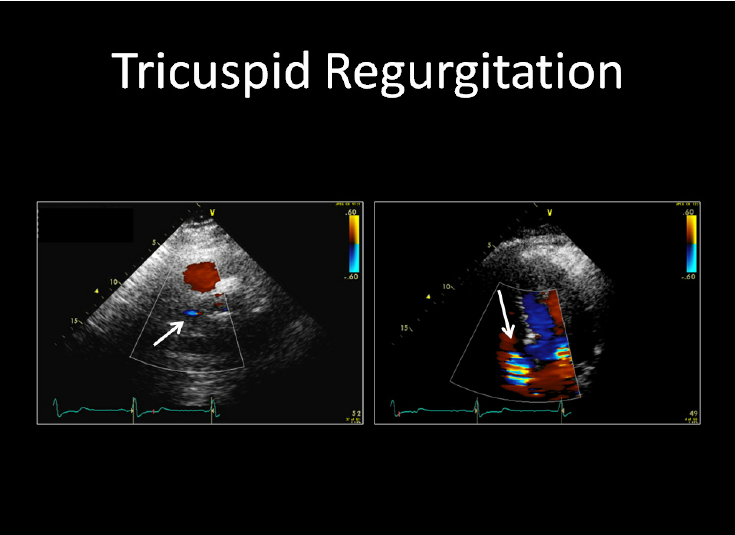
Tricuspid regurgitation is primarily diagnosed using transthoracic echocardiography with color Doppler, which assesses severity, mechanism, right ventricular function, and pulmonary pressures.

What echocardiographic feature indicates severe tricuspid regurgitation?

A dense, early-peaking triangular continuous-wave Doppler jet along with systolic flow reversal in hepatic veins indicates severe tricuspid regurgitation.

What are common symptoms of severe tricuspid regurgitation?

Symptoms include fatigue, peripheral edema, ascites, abdominal fullness, hepatomegaly, and features of right-sided heart failure.

How is functional tricuspid regurgitation managed medically?

Medical management includes diuretics for volume overload and treatment of the underlying cause such as pulmonary hypertension, atrial fibrillation, or left-sided heart disease.

When is surgery indicated in tricuspid regurgitation?

Surgery is indicated in symptomatic severe tricuspid regurgitation, progressive right ventricular dysfunction, or moderate tricuspid regurgitation with annular dilation during left-sided valve surgery.

Which surgical approach is preferred for tricuspid regurgitation?

Tricuspid valve repair with annuloplasty is preferred over valve replacement as it preserves right ventricular function and has fewer long-term complications.

MCQ Test - Tricuspid Regurgitation Causes Symptoms Diagnosis Management Explained

Progress:
0/15
Time: 00:00

1 A 55-year-old man with long-standing rheumatic mitral stenosis presents with ascites, pedal edema, and a pansystolic murmur that increases on inspiration. JVP shows prominent v waves. What is the most likely mechanism of tricuspid regurgitation?

Explanation:

Pulmonary hypertension secondary to mitral stenosis leads to right ventricular dilation and annular dilatation causing functional tricuspid regurgitation.

2 An IV drug user presents with fever, septic pulmonary emboli, and a new systolic murmur at the left lower sternal border. Which pathological change most likely explains the murmur?

Explanation:

Infective endocarditis in IV drug users commonly affects the tricuspid valve causing leaflet destruction and regurgitation.

3 A patient with carcinoid syndrome develops progressive right heart failure. Echocardiography reveals severe tricuspid regurgitation. What is the underlying pathology?

Explanation:

Carcinoid heart disease causes plaque-like fibrous deposits on tricuspid valve leaflets leading to restricted motion and regurgitation.

4 A 70-year-old woman with permanent atrial fibrillation develops severe tricuspid regurgitation despite normal pulmonary pressures. The most likely mechanism is:

Explanation:

Long-standing atrial fibrillation causes right atrial and tricuspid annular dilation resulting in atrial functional tricuspid regurgitation.

5 A patient with severe tricuspid regurgitation has a relatively soft murmur despite marked symptoms. What best explains this finding?

Explanation:

In severe TR with low RV pressure, the murmur intensity may be soft due to reduced pressure gradient.

6 A patient undergoes mitral valve replacement. Intraoperative assessment shows moderate tricuspid regurgitation with annular diameter of 42 mm. Best management?

Explanation:

Guidelines recommend tricuspid valve repair if annular dilation (>40 mm) is present during left-sided valve surgery.

7 A patient with a permanent pacemaker develops worsening right heart failure. Echocardiography shows the lead crossing the tricuspid valve. Mechanism of regurgitation is:

Explanation:

Pacemaker or ICD leads can interfere with leaflet coaptation causing tricuspid regurgitation.

8 In severe tricuspid regurgitation, which Doppler finding best confirms severity?

Explanation:

A dense, early-peaking triangular continuous-wave Doppler jet indicates severe tricuspid regurgitation.

9 A patient with severe tricuspid regurgitation develops marked ascites and hepatomegaly. The primary pathophysiological mechanism is:

Explanation:

Tricuspid regurgitation causes systemic venous congestion leading to hepatomegaly, ascites, and edema.

10 Which clinical sign best differentiates tricuspid regurgitation from mitral regurgitation on examination?

Explanation:

Right-sided murmurs, including TR, increase with inspiration (Carvallo sign).

11 A patient with severe tricuspid regurgitation is planned for surgery. Which option is generally preferred?

Explanation:

Tricuspid valve repair with annuloplasty is preferred as it preserves RV function and reduces complications.

12 Which factor most strongly predicts poor prognosis in patients with severe tricuspid regurgitation?

Explanation:

Right ventricular dysfunction is the most important determinant of prognosis in tricuspid regurgitation.

13 A patient with chronic lung disease develops tricuspid regurgitation. The primary precipitating factor is:

Explanation:

Chronic lung disease causes pulmonary hypertension leading to RV dilation and functional tricuspid regurgitation.

14 In severe tricuspid regurgitation, hepatic vein Doppler typically shows:

Explanation:

Systolic flow reversal in hepatic veins is a hallmark of severe tricuspid regurgitation.

15 Which scenario most strongly supports primary rather than functional tricuspid regurgitation?

Explanation:

Carcinoid syndrome causes primary structural damage to the tricuspid valve, unlike functional causes.

Test Results

0%
0/15
0
Correct Answers
0
Wrong Answers
00:00
Time Taken
0
Skipped
View Exam Mode MCQs (1766907197-index-2025-12-28T130224.395.html)

Related Articles

Comments