Medical Disclaimer: This is educational content only, not medical advice. Consult a licensed healthcare provider for diagnosis/treatment. Information based on sources like WHO/CDC guidelines (last reviewed: 2026-02-13).
This article is being expanded for more depth. Check back soon!
Normal Development in Pediatrics Milestones Growth and Development Guide
Frequently Asked Questions
What is normal development in pediatrics?
Normal development in pediatrics refers to the progressive acquisition of motor, language, cognitive, social, and adaptive skills in a predictable sequence from birth through adolescence.
What are the main domains of child development?
The main developmental domains are gross motor, fine motor and vision, language and communication, social and personal development, and cognitive/adaptive skills.
What are the basic principles of normal development?
Normal development follows cephalocaudal progression (head to toe), proximodistal progression (center to periphery), and moves from general movements to specific refined skills.
When does a baby normally achieve social smile?
A social smile is normally achieved by around 6–8 weeks (2 months) of age.
At what age should a child sit without support?
Most infants sit without support by around 8–9 months of age.
When does a child typically start walking independently?
Independent walking is usually achieved by 12–15 months, and walking up to 18 months may still be within normal limits.
What is the normal language milestone at 2 years?
By 2 years, a child should have a vocabulary of about 50 words and be able to form two-word phrases.
What is stranger anxiety and when does it appear?
Stranger anxiety is a normal developmental social response where infants show fear of unfamiliar people. It usually begins around 6–9 months.
What are developmental red flags in gross motor development?
Red flags include no head control by 4 months, not sitting by 9 months, and not walking independently by 18 months.
What are language development red flags?
Red flags include no babbling by 9 months, no meaningful words by 18 months, and no two-word phrases by 2 years.
Why is developmental screening important?
Developmental screening helps detect delays early, allowing timely intervention with therapies that improve long-term outcomes.
Which tools are commonly used for developmental screening?
Common screening tools include the Denver Developmental Screening Test (DDST), Ages and Stages Questionnaire (ASQ), and Bayley Scales of Infant Development.
How does prematurity affect milestone assessment?
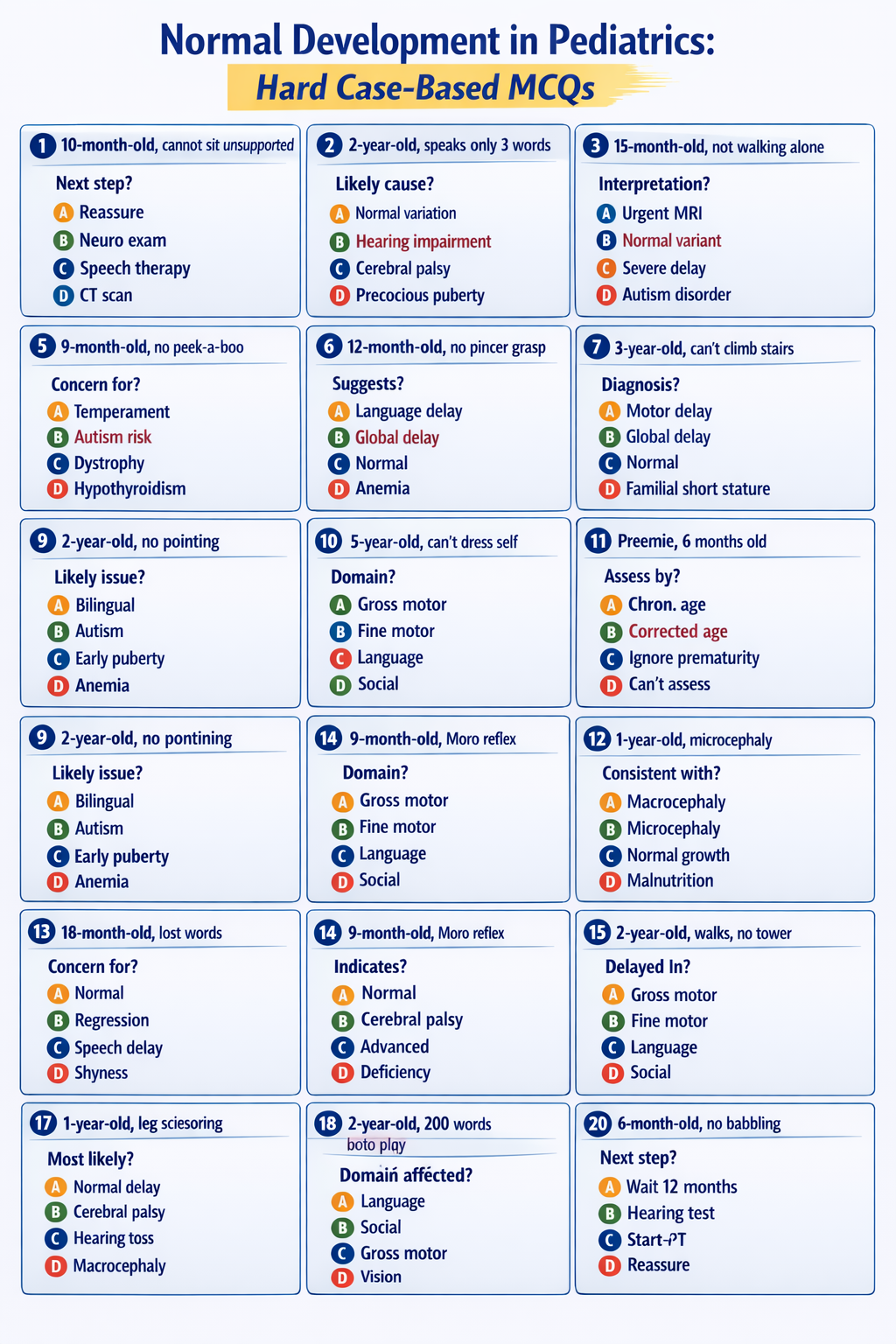
Premature infants should be assessed using corrected age (adjusted for gestational age) until about 2 years of age.
What factors influence normal child development?
Development is influenced by genetics, nutrition, health status, family interaction, environment, stimulation, and socioeconomic factors.
When should parents seek medical evaluation for developmental delay?
Parents should seek evaluation if milestones are significantly delayed, if there is developmental regression, or if red flag signs such as poor eye contact, no speech, or abnormal muscle tone are present.
MCQ Test - Normal Development in Pediatrics Milestones Growth and Development Guide
Progress:
0/0
Time: 00:00
No MCQs available for this article.